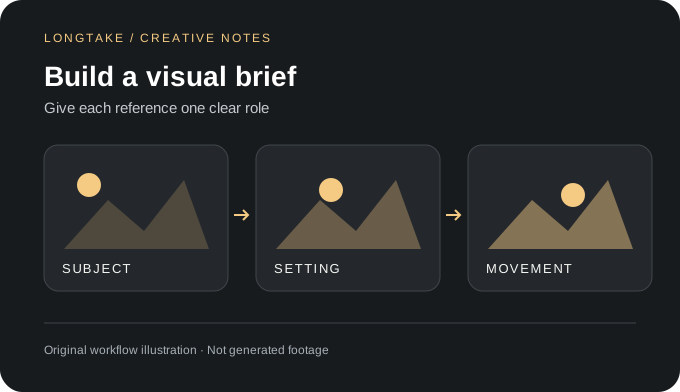
Separate appearance from performance
The documented Kling 2.6 Motion Control endpoint takes a character image and a motion-reference video. The still communicates appearance; the video supplies the performance to transfer.
Learn Kling Motion Control's character-image and motion-video workflow, including reference preparation and checks for readable body movement.
This is a model feature guide. This model is not listed in Longtake's current catalog; the workspace offers other models.
The documented Kling 2.6 Motion Control endpoint takes a character image and a motion-reference video. The still communicates appearance; the video supplies the performance to transfer.
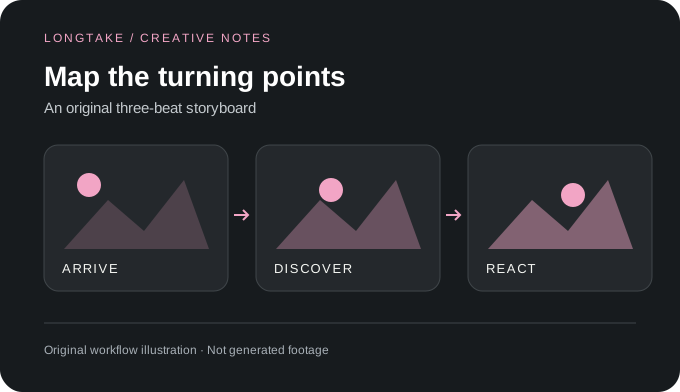
For a greeting animation, record a single visible wave with an unobstructed arm and a stable camera. A complicated performance with overlapping bodies makes the intended movement harder to isolate during review.
Inspect hands, joints and body proportions at the start, peak action and finish. A recognizable character in the first frame is not enough if its silhouette breaks during the transferred gesture.
Source: https://fal.ai/models/fal-ai/kling-video/v2.6/standard/motion-control. Checked October 16, 2026. Illustrations and scene briefs are original creative examples, not generated samples.
This page explains the documented Kling 2.6 Standard Motion Control endpoint. Kling 3.0 Motion Control has a separate guide and should not be assumed to share every setting.
This workflow uses a reference video to define movement. A text description does not replace the endpoint's required character image and motion video.